
Stop Satisfying Demand. Start Generating It.
Most consultants wait for clients to come to them. Here's why that's a losing game and the three-stage campaign that flips the script.

Hi, I’m Rich. Welcome to my weekly newsletter where I share systems and frameworks for scaling your consulting practice from $0 to $1m+ in revenue.
You can get 1:1 personal coaching or explore my course: Indispensable Consulting Systems.
Are you wasting time trying to satisfy demand?
You refresh LinkedIn, tweak your website copy again, post something you hope will land, and wait. Maybe someone Googles the right phrase and finds you. Maybe a referral comes through. This is what most consultants call marketing. It's not. It's waiting.
A common mistake is spending too much time trying to satisfy immediate demand rather than generating it.
You see this in how people position themselves, the messaging on their websites, and their posts on social media.
Let me refer back to this graphic.
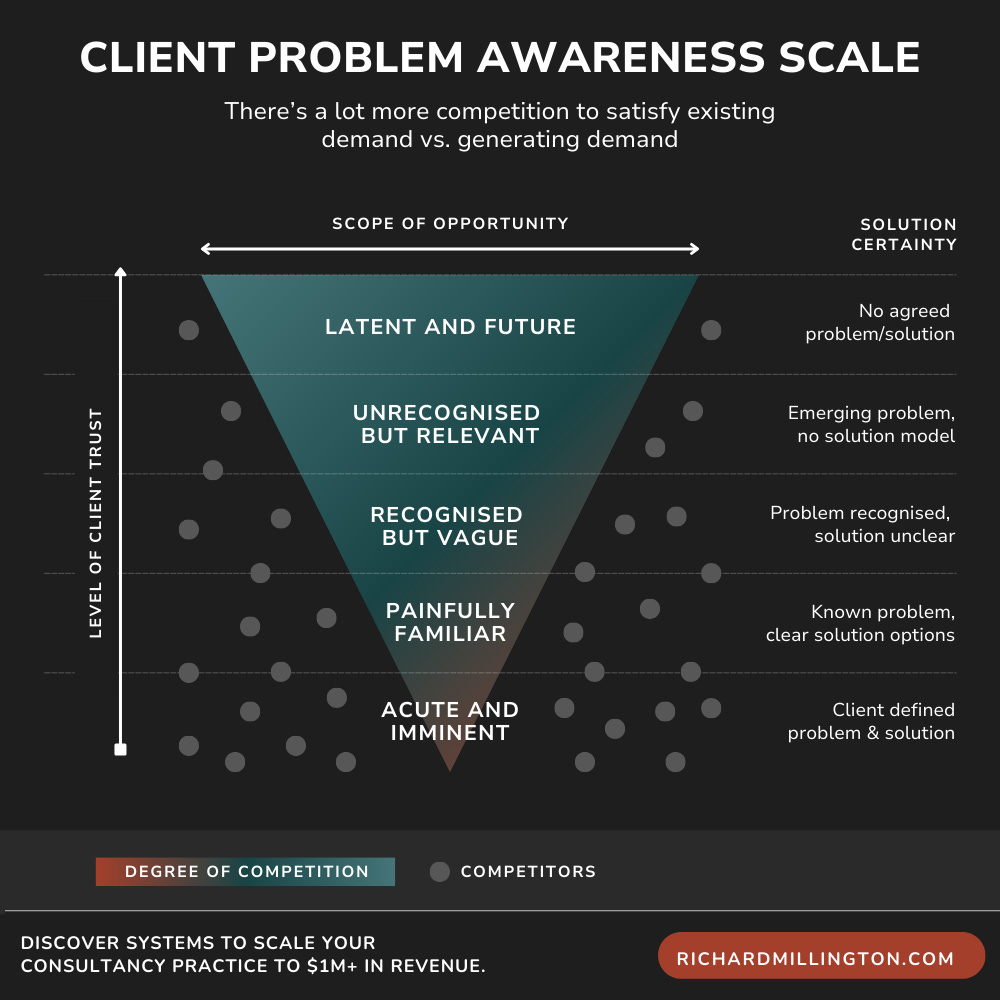
The vast majority of you are one of the many consultants/freelancers sitting at the bottom of this inverted pyramid waiting for a prospective to contact you with a clear problem and knows the solution they want.
In short, you’re satisfying demand.
When you’re optimising for this (website copy, outreach, marketing) your growth is restricted to three things:
The quantity of prospects that experience that need.
The frequency at which needs arises.
Your ability to win competitive situations (and the compromises on pricing it requires).
And that’s always going to be a struggle.
Pretty much everyone on Upwork falls into this category. And there’s no shame in it - but it is limiting. You’re essentially an interchangeable resource. You’re a bit like a plumber - if there’s a leak, a plumber is called to fix it. The plumber is somewhat interchangeable (apologies to plumbers).
A more relatable example might be a SaaS company selecting a new CRM platform vendor. They might hire a consultant to compare the options and recommend a solution.
The upside of this is that you can skip the scoping and diagnosing stages and focus on your credibility, relationship-building, and pricing. The downside is that it’s typically far more competitive, and cost becomes a primary concern.
When the client knows the problem and the solution, the individual consultant becomes much more interchangeable. This is why these fully scoped out projects often lead to RFPs, (which you should avoid).
The Power Of Generating Demand
You should focus the majority of your efforts on generating demand. This means helping prospects become more aware of the problems they encounter, more familiar with their true causes, and able to present new, unique solutions.
Generating demand is when you make your niche:
More aware of the problems they encounter.
More aware of the solutions to those problems.
A Classic Example Of Generating Demand
The difference between the two approaches couldn’t be clearer
Compare these two examples:
An IT consultant who satisfies demand waits until a company’s systems crash and they urgently Google “cybersecurity incident response”.
An IT consultant who generates demand publishes research on “hidden single points of failure in mid-sized firms” - and executives begin asking, “Are we exposed without realising it?”
Which consultant do you think will be the most successful?
This isn’t theoretical either. Rachel Tobac provides a fantastic example in this video of how to generate demand from largely unforeseen issues.
Can you imagine any airline exec watching that and not wanting to check their organisation wouldn’t fall for this? And who do you think they will contact to resolve that?
In a single video, she made organisations aware of the problem and now they need to contact her for help with the solution. Better yet, when people learn about the solutions from her they’re very unlikely to want the solution from anyone else.
That’s generating demand!
(Aside: All of Rachel’s promotional work is amazing).
It’s an extreme example, but you can probably begin thinking of similar approaches to generate demand of unseen or vague issues.
Don’t Wait For The Whims Of The Market To Bless You With Clients
If you want to stop being buffeted around by market forces and drive your consulting practice to where it needs to go, it’s critical you shift from satisfying demand to generating demand.
This won’t happen overnight.
It involves undertaking a lot of research calls, identifying problems, naming the problem, understanding the solutions, and then running a campaign to generate interest.
These are the raw ingredients upon which you build everything else.
Sometimes you need to take an exploratory approach by publishing various content/ideas and seeing what sticks/resonates. Then you gradually turn what resonates into services.
You Should Be Running Marketing Campaigns To Create Demand
The really hard part about all of this is seeing the opportunities.
It’s seeing the place where:
The frustration exists, but feels persistent.
The problems aren’t widely known.
The causes of the problems are misunderstood.
The solutions aren’t widely known.
And then you need to find the right language that resonates on both the emotional and intellectual levels.
This is hard.
Which is a good thing - it’s not something AI can do well (at least not in my opinion).
But the process is always to create the disconnect, prove the better way, and then build trust.
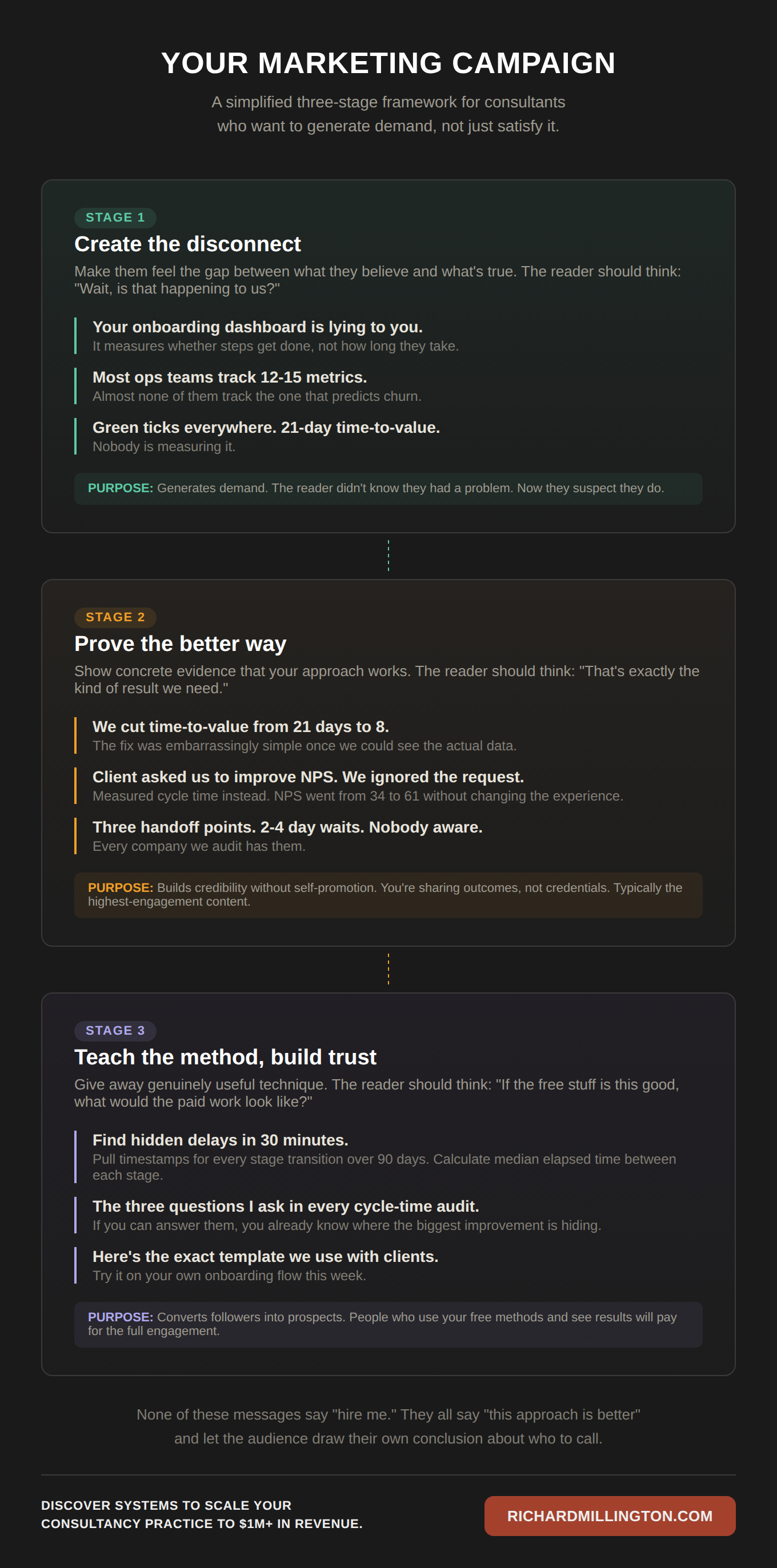
Phase 1: Create the disconnect. Make your audience aware that a problem exists that they've been ignoring or misunderstanding.
Phase 2: Prove the better way. Show them that a solution exists, what it looks like, and why the current approach is costing them.
Phase 3: Build trust. Demonstrate through depth, specificity, and repeated exposure that you are the person who understands this problem best.
The medium(s) you use to undertake this campaign will vary - and should be adapted to what you feel more proficient and comfortable using, but the process is repetitive.
Once you begin thinking of your content as a marketing campaign rather than one-off thought pieces, it becomes much easier to plan a full calendar.
How FeverBee Used This Method
Here’s a recent example from my consulting practice.
Many of our contacts were suddenly being told they need to ‘do more with AI’ but didn’t really know what that meant. We turned that annoyance into a defined problem, solution, and eventually a service: the AI Ready Communities program, which has generated around $30k in the past month.
You can see the entire campaign I ran:
Now would be a bad time to close your forum (makes people aware of the problem)
Bad community hygiene is beginning to cause big problems (more problem awareness and naming the problem)
The evolution of enterprise communities (framing the problem)
Join our ‘AI Ready Communities’ Program (solution awareness)
The unique value of communities is changing (familiarity with the solution)
Your community needs to appear in support search results (more problem awareness)
“I run a messy community of 100k+ questions” (high solution awareness)
This isn’t the first time we’ve used this approach. A few years ago, we picked up on vague reports of organisations ‘struggling with data’. We zeroed in on the specific causes, turned it into our Community Intelligence services, and signed $100k+ in business within two months of launching the campaign.
Again, we’re not hoping and praying that clients stumble across us. We’re directly generating demand by understanding the problems and helping clients become increasingly familiar with the solutions.
Pick one frustration your niche keeps mentioning but hasn't clearly named yet. Write the first piece of content that names it. That's the starting point of your first demand generation campaign. Everything else builds from there.
Good luck
-Rich
Connect with Rich
Are you new to the newsletter? Subscribe for free
Follow me on LinkedIn for more insights
Learn to write persuasive business proposals with my Proposal Mastery course.
Get 1-to-1 personal coaching. Get a personal coach to help you grow your consultancy practice. Tackle topics like positioning, client acquisition, delivering exceptional value, industry leadership, and building the systems to thrive. Hit reply or learn more about my coaching approach.