
The Client-Problem Awareness Scale: How To Construct A Pipeline Of Projects From Past Clients
How to translate the trust you've earned with clients into new opportunities you can tackle with the client. The key is to help clients see the problems they were previously ignoring.

Hi, I’m Rich. Welcome to my weekly newsletter where I share systems and frameworks for scaling your consulting practice from $0 to $1m+ in revenue.
You can get 1:1 personal coaching or explore my new program: Indispensable Consulting Systems.
Why Initial Success Often Slows To A Crawl
Last week, during a coaching call, a consultant told me about a relatively common problem. They had attracted around 6 to 7 clients, undertaken projects, and the client was happy, and he had three testimonials.
And now he was back, looking for clients again - and it was a struggle.
Yes, it’s always going to be a struggle if you’re back to square zero after every client engagement.
He had invested a great deal of time in attracting the work and doing it, and was now letting all the trust and goodwill he had accumulated go to waste.
Instead, he was once again competing in the right place for future work.
Trust Is More Valuable Than Income
I can’t stress this enough - especially in an increasingly AI world - a client trusting you is more valuable than anything they pay you (especially in the long-term).
Your most likely source of future clients is past clients.
The key to long-term sustainable growth of any consulting practice is repeat clients.
If you’re not able to attract work from past clients, you will quickly stall and spend all your time attracting new clients.
The obvious question then is simple. If you’ve just completed a project with a client, how do you attract more business from them?
Turning One Project Into Many
The end of a consulting project should also be an opportunity for a new beginning.
In every consulting project I’ve worked on, I’ve kept notes on other issues I can help a client address or solve. Often, the problem I’m working on has related issues, deeper root causes, or tangential/similar situations elsewhere in the organisation.
When I feel I have established the right level of trust and rapport with the client, I ask if they would be open to me sharing a few out-of-scope problems I’ve noticed during a separate call (always make it clear you’re doing this outside of the current scope of work).
You will notice this feeds directly into the second stage of our sales process.
I’ve found, in most cases, they are happy to listen. In the call, I try to provide as much value as possible - highlight what I’m seeing, learning from other organisations, identifying some clear causes and solutions, etc…
Not only does this deliver additional free value for them, but it also often becomes a repeat project for me. And the flywheel effect begins. The more I work with an organisation, the more trust I earn, and the more likely they are to listen to and trust me to solve future problems for them.
If you do this enough, you will build up a base of long-term clients who not only automatically turn to you when they want support, but you can also prompt them to hire you when you want work.
But this raises a simple question: how do you identify the kinds of issues you can help an organisation solve?
This is where we introduce the Client-Problem Awareness Scale
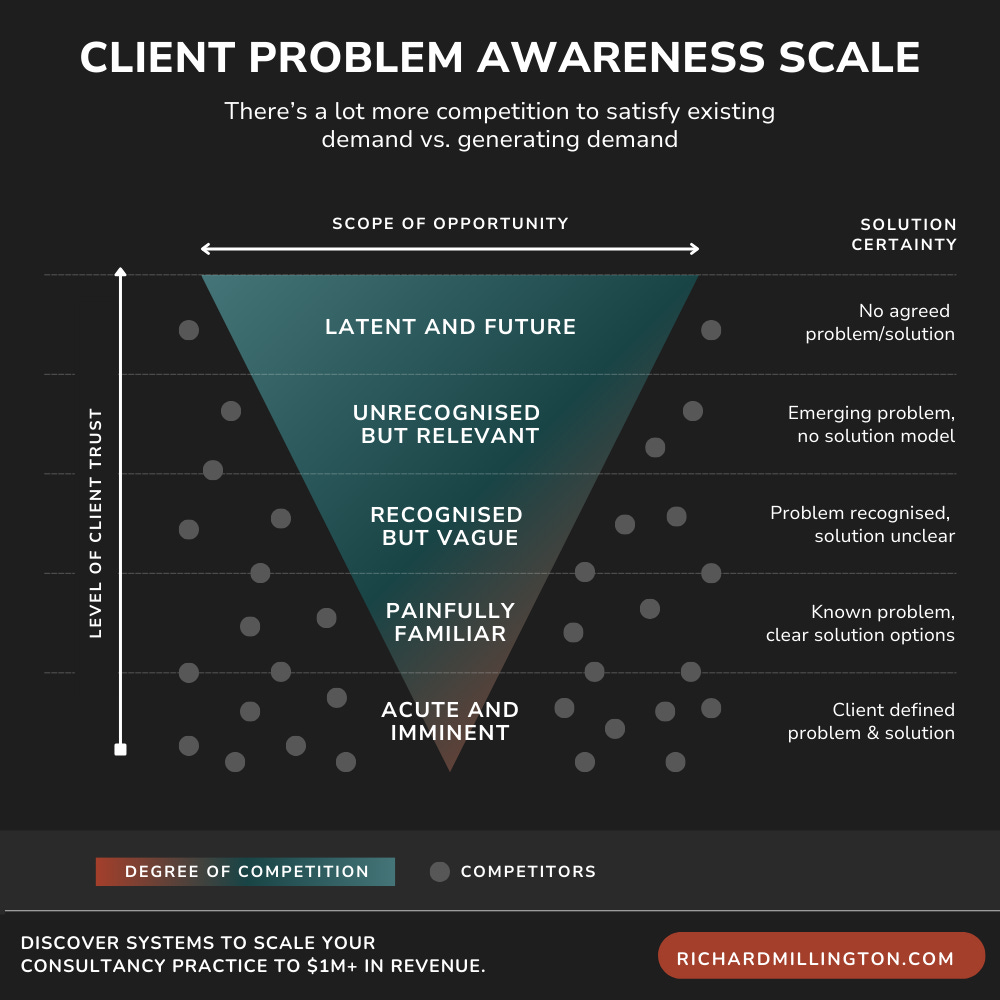
The Client-Problem Awareness Scale
The Big Mistake A Lot Of Consultants Make
The vast majority of consultants make a big mistake - they wait for a prospect to approach them with a clearly defined problem and solution that they can solve.
However, if a client has defined the problem and solution, then you’re not adding much unique value, and clients will largely make their decision based on price and relevant case studies/testimonials.
Often, they will reach out to half a dozen consultants they find through a generic search. The level of competition is high, the odds of winning are low, and your revenue is capped.
You’re essentially a plumber fixing a leak in this role. There’s no shame in it, but it’s self-limiting.
However, the more you can help clients identify and define new solutions to existing problems or to entirely new problems, the more value you add and the greater the potential reward.
This doesn’t just happen directly in calls. It happens via your content and other marketing strategies. But let’s work through the layers (from the least to the most opportunity).
In your content, messaging, and client engagements, you should consistently help clients understand/define the problems they face and the potential solutions.
Helping clients become familiar with problems and potential solutions is how you begin to shift from satisfying demand to generating it.
A Breakdown Of Potential Problems and Solutions
Client problems don’t arrive in a single form. They exist on a spectrum - and where a problem sits on that spectrum determines the kind of work, the level of competition, and how lucrative the opportunity is.
Here’s what that looks like in practice.
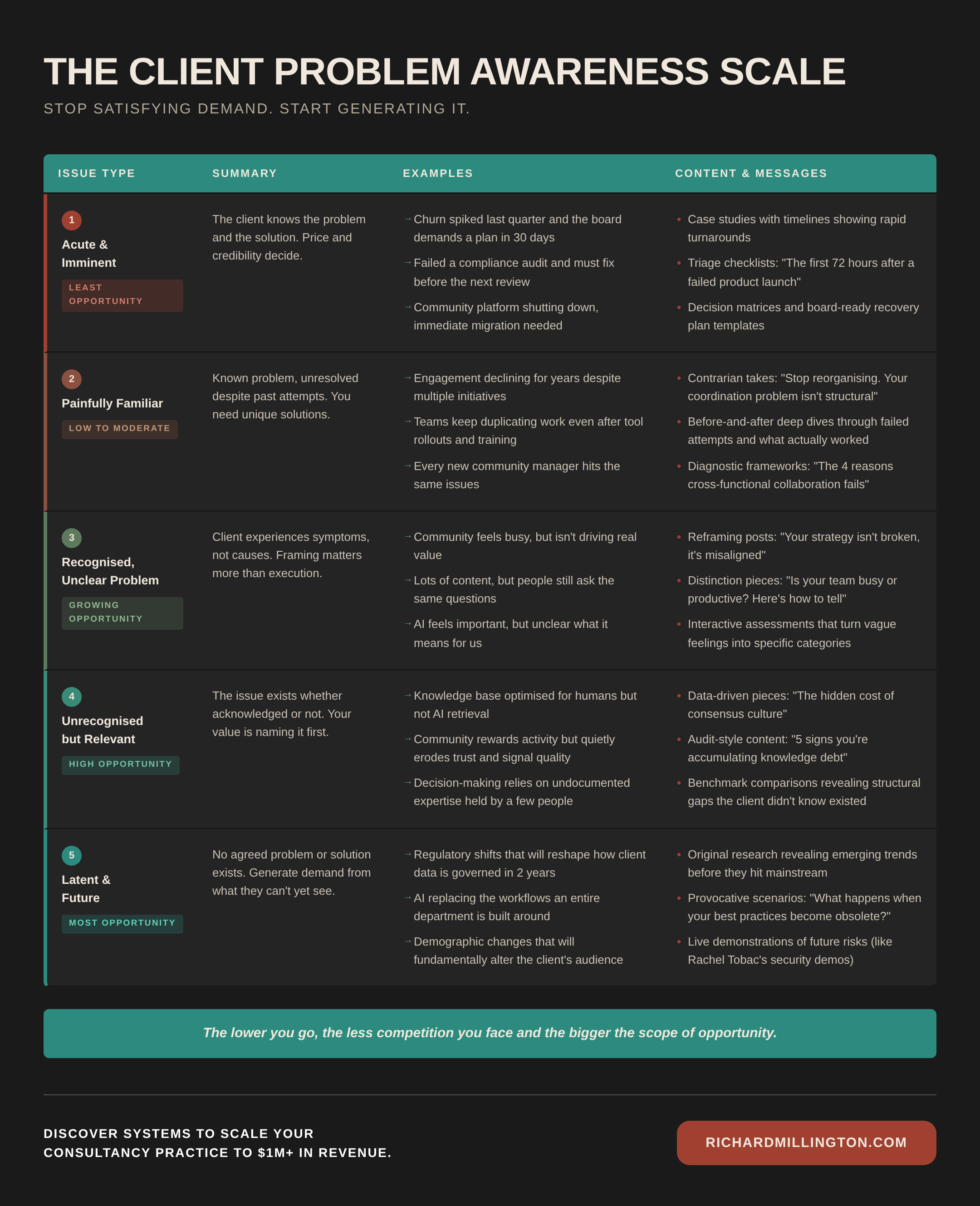
1. Acute & Imminent Problems (least opportunity)
“This is broken and we need help now.”
In these situations, the client is often very familiar with the problem, the kinds of solutions to expect, the kind of solution they expect, and roughly what the work should involve.
The problem is visible, urgent, and often externally triggered.
Examples:
“Our churn jumped last quarter and the board wants a plan in 30 days.”
“We failed a compliance audit and need to fix this before the next review.”
“Our community platform is being shut down - we need to migrate immediately.”
They’re not typically looking for the consultant to expand or redefine the scope of work. They’re looking for trustworthy people who can deliver the outcome they need within a fixed time frame.
In these situations, it’s relatively clear what your deliverables will be - which means price and past success on similar projects become the determining factors of whether you get the work.
2. Painfully Familiar (Recurring) Problems
“This keeps happening and we’re tired of it.”
There are the perennial problems the organisation is aware of but has probably struggled to solve it before. It helps to have a clear process to solve problems in these situations
Examples:
“Engagement has been declining for years despite multiple initiatives.”
“Our teams keep duplicating work, even after tool rollouts and training.”
“Every new community manager runs into the same issues.”
The challenge here isn’t defining the problem (unless you can establish a different root cause), but in developing potentially unique, new, solutions based upon your uniquely advanced understanding of the problem.
Before proposing a solution, you should earn the trust of the client, understand what they’ve tried before - and why it didn’t work, and avoid simply giving them what they request. Being able to craft a solution to the unique context of the client is critical at this level.
3. Recognised Issue, Unclear Problem
“We know something isn’t right, but we can’t define it.”
This is where the opportunity really begins to present itself. It’s where the client experiences the symptoms of the problem rather than the root cause. You will notice this when the language starts to get a little vague and staff members describe different symptoms - but all related to the same core problem.
Examples:
“Our community feels busy, but it’s not really driving value.”
“We have lots of content, but people still ask the same questions.”
“AI feels important, but we’re not sure what that means for us.”
You will notice that the client experiences symptoms rather than causes. The language becomes a little less precise - watch out for conflicting descriptions in any client calls.
There isn’t a fixed solution yet. So you might sell diagnostic deliverables or even promote the concept of this kind of service. You need to win the battle to frame the problem the right way.
This space offers the greatest opportunity for many consultants.
4. Unrecognised but relevant
“That’s not really a problem… is it?”
Now we move into the realm of helping clients identify problems they didn’t even know they had - but are extremely relevant.
This is where you become that category of one - helping clients understand issues which they previously didn’t acknowledge, or though they were unavoidable. It really helps to have good relationships with prospects before going into this tier.
These are often structural, systemic, long-term issues that are constantly ignored.
Examples:
A knowledge base optimised for human reading but not AI retrieval.
A community that rewards activity but quietly erodes trust and signal quality.
Decision-making that relies on undocumented expertise held by a few individuals.
The key here is helping clients see the problem and its structural causes. Again, you might name the problem here, but it goes deeper than that. You need ways to help the client prove the problem exists.
You will notice that this often involves helping people understand that what they think might actually be wrong.
5. Latent / future
“Why should we care about this at all?”
The final tier is the one with no pain at all. There isn’t an immediate problem per se. There is no predefined scope, solution, or urgency
Instead, you’re looking ahead and helping clients prepare for something they might not see coming yet - or seize an opportunity the client wasn’t aware existed.
The value is preventative or compounding. This work only happens when the consultant is trusted as a sense-maker.
Examples:
Redesigning how expertise flows before AI amplifies existing weaknesses.
Preparing a community for scale before growth makes change expensive.
Building institutional memory before key people leave.
At this level, you will likely be in constant contact with past and present clients, even if nothing is immediately wrong. You should have the kind of relationships where you regularly catch up and help scope out what the future of the organisation/unit might look like, etc…
Next Steps
Pretty much every consultant I know who is thriving has a large and growing pool of past clients they repeatedly engage with multiple projects over many years. They treat every new client as a client for life, put trust before profits, and aim to find as many ways to help that client as possible.
Over time, this naturally opens the door to opportunities (either client-initiated or otherwise) for future projects and work. There are plenty of organisations, such as Mars, Microsoft, and USP, with whom I’ve worked for years on a wide variety of projects.
I’d estimate around 75% of my revenue comes from repeat clients these days (vs. 25% from ad hoc clients).
The key is to earn the trust of clients, build relationships throughout the organisation, and constantly deliver useful insights and value (even if it’s not in scope). And, eventually, new opportunities will open up.
Good luck!
Connect with Rich
Are you new to the newsletter? Subscribe for free
Follow me on LinkedIn for more insights
Learn to write persuasive business proposals with my Proposal Mastery course.
Get 1 to 1 personal coaching. Get a personal coach to help you grow your consultancy practice. Tackle topics like positioning, client acquisition, delivering exceptional value, industry leadership, and building the systems to thrive. Hit reply or learn more about my coaching approach.