
What Should Consultants Charge?
An updated guide for setting your fees, placing a value on your time, and never fearing you're charging too much (or too little)

New Program: Consulting Foundations

Next month, I’m opening enrolment for my Consulting Foundations program. This is a guided, 4-week cohort-based program to help you get the big decisions right.
By the end of this program, you will have:
Selected the right niche for you.
Deciding on your positioning within that niche.
Selling the right services / solving the right problem.
Set your rates for clients.
You can sign up here.
In this post, I want to share the program's philosophy and offer ideas on how to better set your rates.
Two Critical Principles Of Pricing
Here’s a statement that seems obvious in hindsight, yet it’s difficult to fathom why it’s not more widely accepted.
→ You should know what your services should cost
I know, I know, that sounds obvious…but pretty much everyone is still playing the ‘guess the highest number the client is willing to pay’ game.
Let me follow this with another statement which seems obvious in hindsight.
→ Your pricing reflects your strategy
Again, sounds obvious - but as we’re about to discover, almost every consultant completely violates both of these principles.
The Mistake Most Consultants Make When Setting Their Rates Today
Most consultants I’ve coached have tried to set their fee by navigating between two competing fears.
They might scare an interested client away by charging too much.
They might leave money on the table by charging too little.
These fears can be traced to the same root cause: the consultant doesn’t know what a fair market rate is for their services.
As a result, most consultants set their rate by playing a psychologically stressful game of ‘guessing the highest number a client might be willing to pay’.
They ask a few questions to gauge a client's budget, estimate the maximum a client is willing to pay, name a price, and hope for the best.
This is a terrible approach to setting your rates.
I recently shared a template for quoting a fee when you don’t know a client’s budget. But it’s worth refreshing the problems with this approach.
You will waste time chasing no-go projects. If you’re trying to guess the maximum a client will pay, then it’s likely the client has no idea what your services are likely to cost. This means there is a high likelihood that your client will experience ‘sticker shock’ when you get the quote.
Your final quote shouldn’t be a shock because you’ve already checked you’re in the right ballpark during the sales process (begin with the contact page).
See: The ‘Zero In’ Technique: How Top Consultants Negotiate Fees
You might win a poisoned chalice. Imagine you typically charge $10k to $15k per client and then quote $60k for a big-name client. The difference in expectations between the two projects is huge. The latter will require much greater stakeholder engagement, professionally designed deliverables, and superior project management.
It’s impossible to grow your practice sustainably. If your fees are set by guesswork, it becomes difficult to develop scalable templates and processes. Every client will require a different approach, and it will be challenging to grow anything that scales beyond your capabilities.
This mindset is often perpetuated by a cadre of folks spouting catnip-style advice, such as using ‘value-based fees’ (which don’t work) or ‘just raise your rates’.
Eugh!
Your Pricing = Your Strategy
If you’re not sure what to charge, you don’t have a fee-setting problem - you have a strategy problem.
My coaching programs almost always reveal that pricing uncertainty isn’t about knowing the figure; it’s about having a clear strategy.
The fee you quote a client is the place where your marketing, positioning, and services converge.
Similar to a restaurant, the fee reflects the audience you’ve decided to serve, the problem you’ve decided to solve, your positioning relative to competitors, and your own ability.
If you’re a new consultant with a pamphlet-style website targeting mid-tier organisations, then charging $50k would be a terrible idea. It simply doesn’t align with the rest of what you’re doing.
If you’re a veteran consultant with an industry-leading reputation, a case-study-rich website, and regularly upgrading your skillset through new courses, $50k might make perfect sense.
(Spend time looking at where you land on the Consulting Maturity Model)
So let’s review the typical strategies and pricing tiers.
Strategy And Pricing Tiers
The fees you charge reflect the sand pit you’ve decided to play in.
A common misconception is that higher fees automatically mean higher revenue.
In reality, the more you charge, the smaller the pool of organisations that can afford you. You might (and probably will) find it easier to find five organisations willing to pay you $20k vs. one organisation that will pay you $100k.
I know one consultant who delivers a turnkey marketing system for small businesses. He charges around $1k per project, most of his processes are automated, and each project takes around half a day. He earns $160k working half the year and then spends the second half travelling.
I know another consultant who essentially has one client paying $120k per year. And that’s his entire client roster.
These are extremes, but you get the idea. You don’t maximise revenue by charging as much as you possibly can; maximise revenue by having a clear strategy and executing it terrifically.
❗️ Warning: Don’t Let Your Ego Get In The Way Of Your Success
A quick observation from my coaching clients, you need to prevent your ego from getting in the way of your success.
→ Ego is the enemy of rational pricing decisions.
Yes, I get it, you want to be the most highly-priced consultant in your industry. You want to charge more than all of your competitors. You don’t want to feel that someone’s time is worth more than yours.
Two key things here.
Charging more is easy; winning more is hard. Just name absurdly high fees. Congrats - you are now the consultant with the highest rates in your industry. The problem is that it doesn’t mean you’re going to be attracting many clients at that rate. You want to be smarter than your competitors.
I frankly don’t care how much a competitor charges if I win the client.
High fees = high expectations. The more you charge, the more you run into things like RFPs, SLAs, expectations around providing a project manager, higher design standards, and the need to anticipate providing a team. (And you start running into mid-tier consulting firms). You also run the risk of revenue concentration.
That said, while turnkey projects are an option, I believe you usually need five-figure projects to thrive as a consultant.
Targeting smaller clients often means you’re surviving on morsels. It’s possible to thrive there, but you need to be insanely good at automation.
Six Broad Pricing Tiers To Choose Between
With all of this in mind, here’s a simple overview of the relevant pricing tiers you can consider.
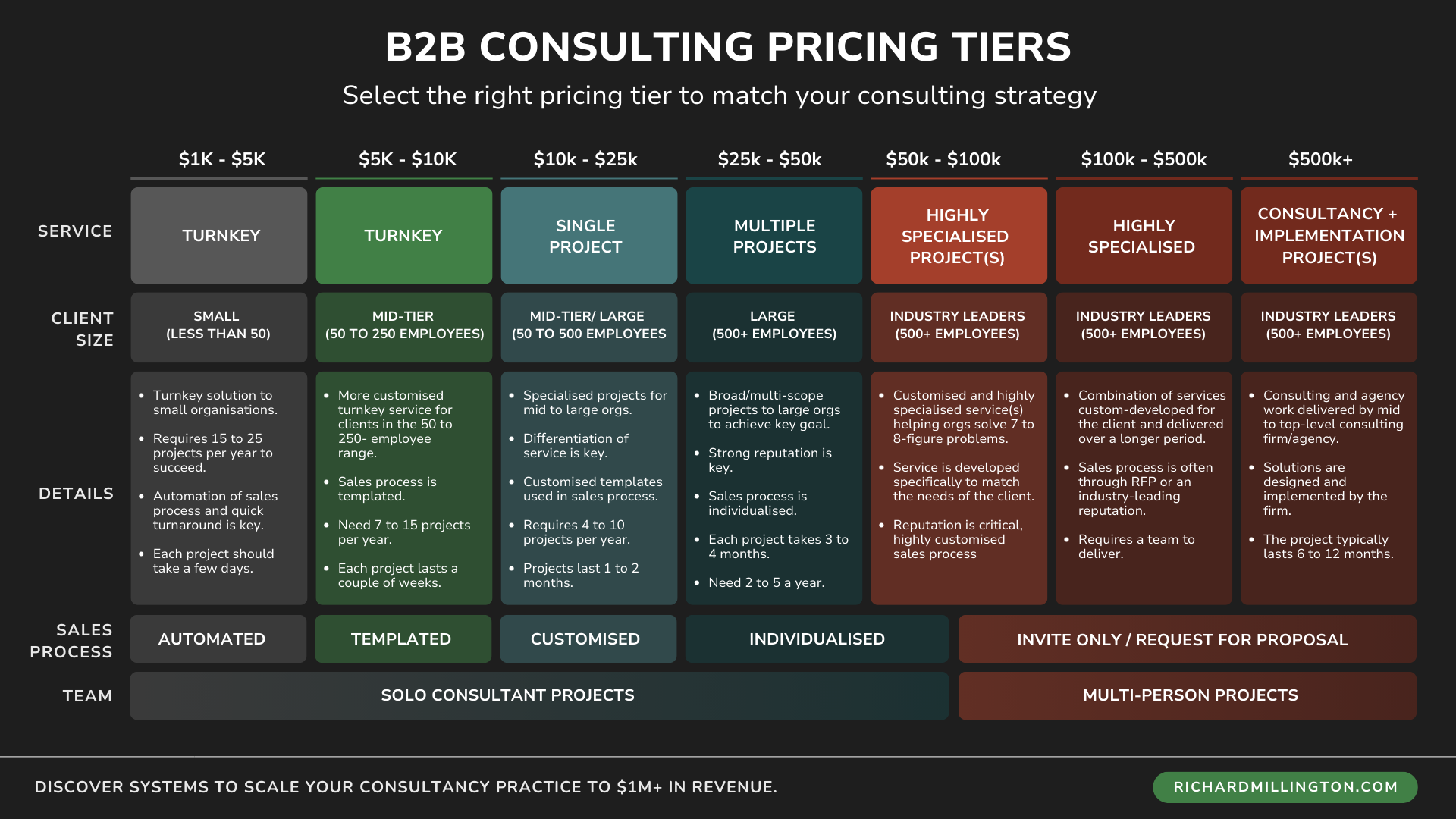

This breaks down into six broad strategies for consultants.
$1k to $5k: Targeting Small Businesses With Quick Turnkey Projects
$5k to $10k: Targeting Mid-Tier Organisations With Turnkey Projects
$10k to $25k: Targeting Mid To Large Organisations With Custom Projects
$25k to $50k: Targeting Large Organisations With Multiple Projects
$50k to $100k: Targeting Industry Leaders With Highly Specialised Project(s)
$100k+ Targeting Industry Leaders With Long-Term Consulting Projects
There’s a 7th tier, as you see in the graphic above, but that’s generally outside the range of solo consultants.
You can now adapt and adjust these as needed. Every context is different. But within your niche, just be clear about:
The size of the organisation you are targeting? (small, mid, large, etc.)
What types of projects are you offering (turnkey, custom, multiple, etc)
The right fee that matches the above.
It’s critically important that everything else you do aligns with this!
Your website, the design of everything you deliver, how you manage projects, the quality of your skillset in facilitation, etc…All has to match the level of what you charge.
Give A Broad Range And Then Zero In
Now, when a client approaches you about a project, you can give a broad range and zero in as you learn more about the project.
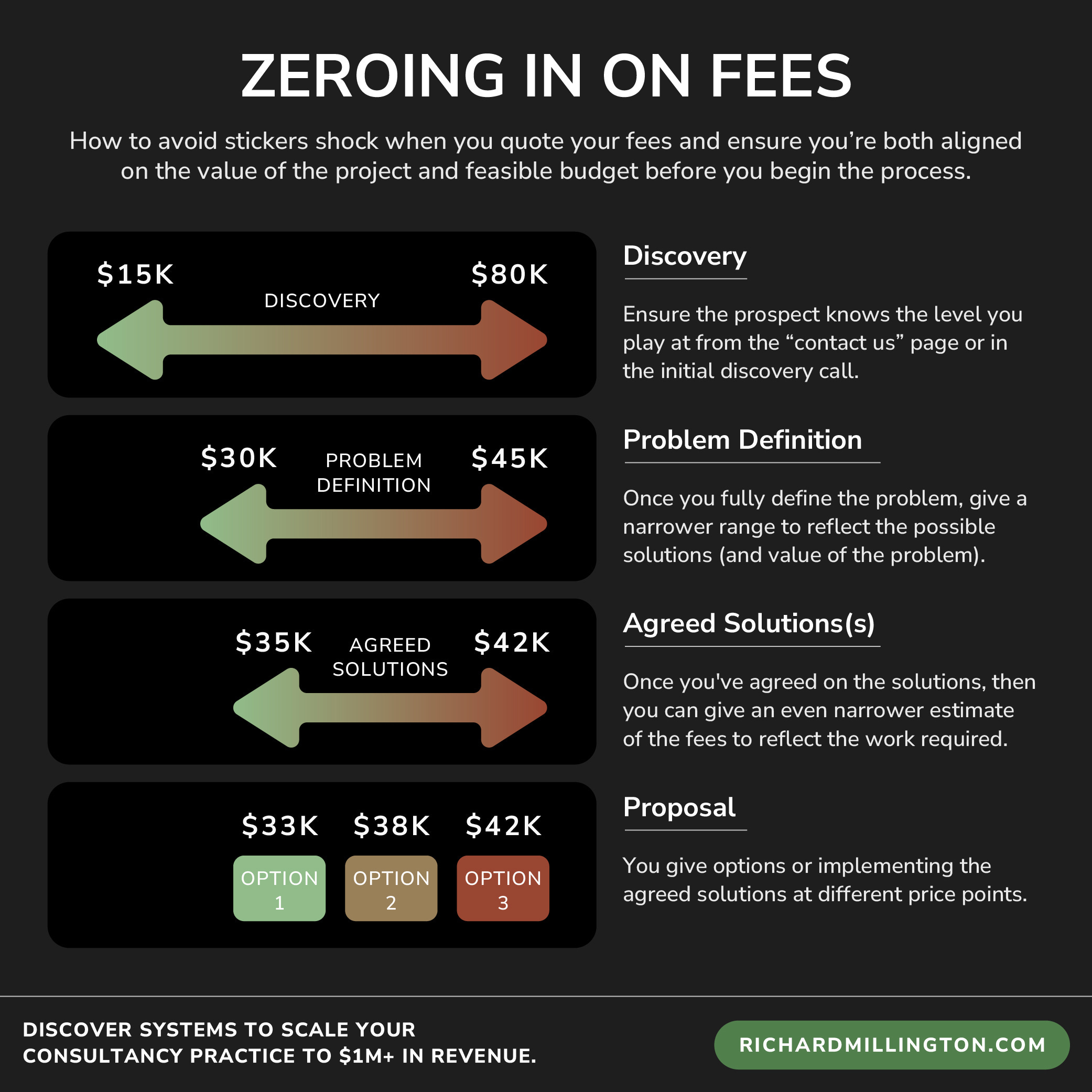
If you follow this process, you’ll never again have to worry about what you should charge, and your clients will never experience ‘sticker shock’. The process becomes a collaborative effort to determine which services are in and out of scope.
If you want to get your pricing right, I highly recommend you sign up for the Consulting Foundations Program.