How To Quote A Fee When You Don't Know A Client's Budget
You shouldn't be worried about leaving money on the table or quoting a budget that's too high if you follow a few basic principles.
Hi, I’m Rich. Welcome to my weekly newsletter where I share systems and frameworks for scaling your consulting practice from $0 to $1m+ in revenue.
You can get 1:1 personal coaching or explore my new program: Indispensable Consulting Systems.
Stop Trying To Guess The Highest Acceptable Number
You’ve had your first great call with a client; it went well. Now the client wants to know what you charge.
Now you’re caught in a bind.
You don’t want to leave money on the table, nor do you want to scare away the client with a high fee.
Instead, you formulate your best guess and hope they agree.
This is the highest-acceptable-number approach—and it’s entirely the wrong way to go about it.
It’s also precisely what most consultants do.
Here are some alternative approaches.
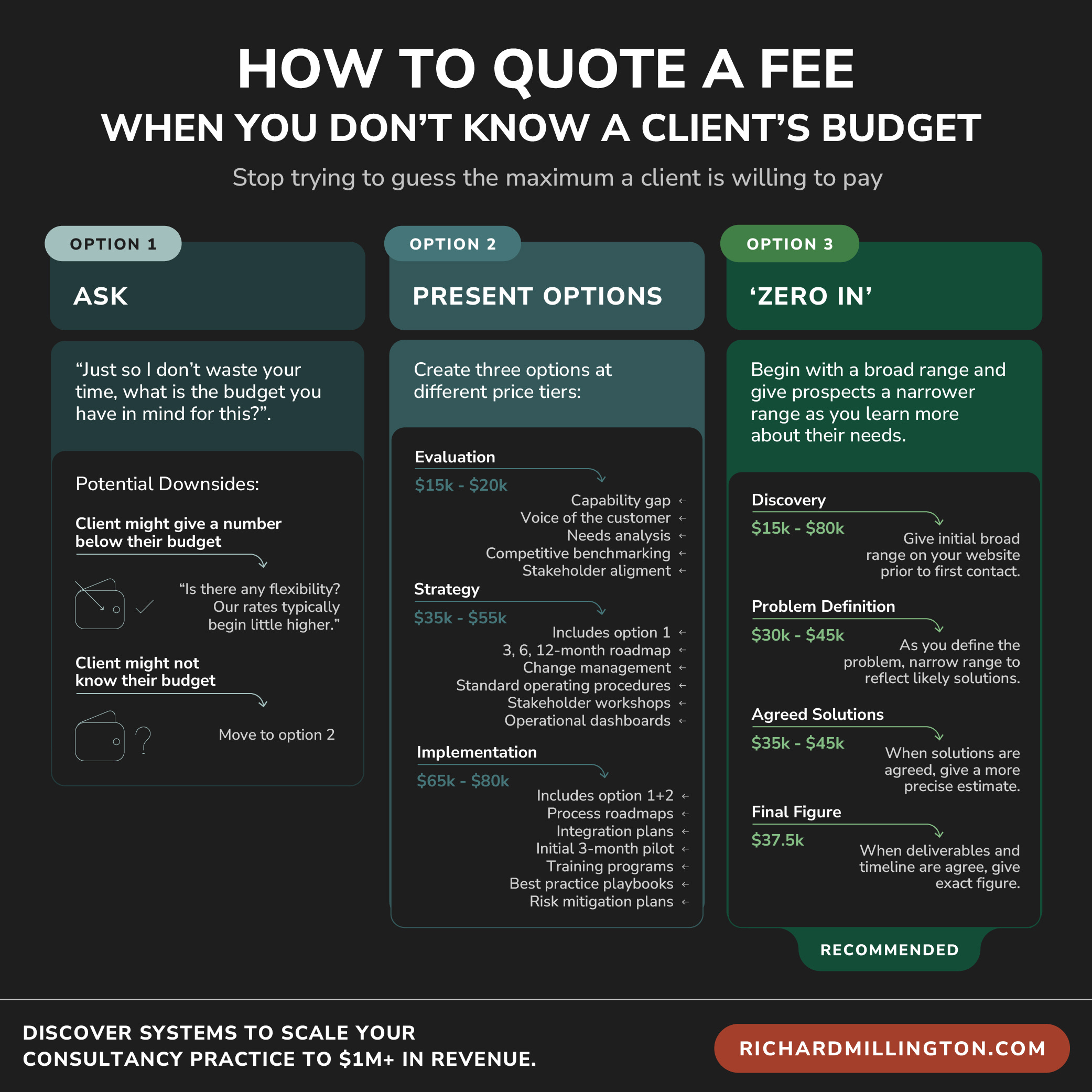
Option 1: Ask - “What is your budget?”
This is so generic it almost sounds old-school today. However, it’s still often remarkably effective. You ask the client what their budget is and charge them that amount. The advantage of this is pretty obvious - you’re giving a budget you know the client is happy with, and you can feel you’re not leaving money on the table.
This has worked for me in the past. There were certainly times when a prospect gave me a much higher budget than I intended to charge.
I used to combine this with “just so I don’t waste your time, what is the budget you have in mind for this?”.
However, there are some downsides to this approach.
First, the client might give a budget below what they would be willing to pay as the opening salvo in an anticipated negotiation. Just because they give a budget doesn’t mean it’s their actual budget. Many clients know exactly what you’re trying to do here.
In this case, you might want to add “Is there any flexibility in this? Our rates typically begin a little higher…”
Second, more often than not, you will receive a comment such as “I’m not sure” or “we’re just exploring options” at the moment. Which is fine—it just means you can move on to one of the options below.
Option 2: Present Options
If you’re not sure of the budget and, for some reason, you’re not comfortable asking, a more straightforward approach is to present low, medium, and high-budget options.
This allows you to design options that suit budgets ranging from $15k to $65k (and more). You can do this, and also include a note that you can customise these to suit the client’s needs.
The advantage is that it gives clients a range of ways to work with you and see the pros and cons of each. You can also structure these so they build on one another.
For example:
Option 1: $15k Diagnosis and Evaluation (minimum investment)
Option 2: $45k Strategy and Roadmap (recommended investment)
Includes option 1
Option 3: $75k Training and Implementation (optimal investment)
Includes options 1 + 2.
You can tweak the language to suit your needs - but you get the idea. The key is to present options and let clients choose the one that best suits their budget.
If you like, you can also present an ‘off the charts’ option to make the others seem favourable by comparison.
The downside is that you still don’t know whether any of the options are within the client’s budget (and you might still be ‘leaving money on the table’).
Option 3: Begin with A Broad Range and Zero In On The Right Fee
The ‘Zero In’ approach is my standard approach to quoting budgets to clients.
In my mind, it’s easily the superior approach.
This begins by listing your broad fee range on your website before a client contacts you.

This ensures they’re in the right ballpark and neither of you is wasting each other’s time.
Then, as you learn about their needs, you narrow the range until you can list a handful of options that suit the budget.
This approach allows you to customise the solution and the budget as you progress through the journey. Often, you won’t even need to create a proposal because everything has already been agreed upon.
The other benefit is that it gives you scope to expand the problem and the potential value of the solution you’re creating.
The critical thing is that the client has an idea of what you charge before you engage in lengthy back-and-forth calls.
Don’t Give Prospects Sticker Shock
The worst thing to do is to give no indication of the budget until the client sees the proposal and experiences ‘sticker shock’. If you give an early indication of the budget, and the client says that doesn’t work for them, that’s good news! It means you’ve both avoided wasting each other’s time.
Believe me, it’s not fun to invest hours in numerous calls and a day creating a proposal for a client who quickly rejects it because they don't have the budget. Eliminating bad opportunities early frees up time to invest in better opportunities.
All three of the above approaches can work, but as you progress in your consulting career, gradually shift from option 1 to option 3.
Make sure you also read the post below to understand how to set your fees.
What Should B2B Consultants Charge Clients? An Updated Strategic Guide To Setting Your Fees
Hi, I’m Rich, welcome to my consultancy newsletter. Please subscribe and check out my best articles.
Good luck!
Connect with Rich
Are you new to the newsletter? Subscribe for free
Follow me on LinkedIn for more insights
Learn to write persuasive business proposals with my Proposal Mastery course.
Get 1:1 personal coaching. Get a personal coach to help you grow your consultancy practice. Tackle topics like positioning, client acquisition, delivering exceptional value, industry leadership, and building the systems to thrive. Hit reply or learn more about my coaching approach.


Good article. I appreciate practice is different in different sectors - but in the NHS and public sector, most commissions are nominally based on an agreed day rate and a set number of days.