
The Most Successful Consultants Work In The Most Boring Sectors
Why you might want to avoid becoming an 'AI Consultant' for the time being and focus on places with maximum opportunity vs. minimum competition.

Hi, I’m Rich. Welcome to my weekly newsletter, where I share systems and frameworks for scaling your consulting practice from $0 to $1m+ in revenue.
Reminder: You have three weeks remaining to enrol in my Consulting Foundations program. This program will ensure you’ve made the four key decisions correctly. This includes selecting the right niche, establishing the right positioning, designing the right services, and pricing yourself appropriately.
In this post, I’m going to explain why selecting the right niche is such a critical thing to do.
Finding The Perfect Tide Pool
I know someone who runs a solo consulting practice earning just over $1m per year.
He helps organisations support and maintain legacy operating systems. Most of his clients are public-sector or government organisations that cannot migrate to an upgraded system. Instead of joining the growing chorus berating them for having outdated systems or becoming one of the legion of consultants trying to serve clients on the new platforms, he supports those stuck on legacy systems.
The genius here is that he is one of the few people in the world who can do this work, and he knows all the players to work with.
He’s not about to compete with any new competitors in this area; it’s almost impossible for anyone else to get up to speed. He’s in a tide pool pretty much all by himself.
And that’s where you want to be!
What Is a Tide Pool?
A literal tide pool is a small pool of water trapped in rocky areas of shore when the tide goes out.

In business terms, it’s what’s left behind when the tide of interest (hype, consultants, venture capital, etc) recedes in favour of the next big thing.
What’s left behind are plenty of organisations and people still working on the problem. Most are unable or unwilling to move on to the next thing. This creates a huge opportunity.
Your challenge is to find the unsexy tide pools that are big enough to sustain you, but not so big as to attract a flood competition.
The Strategic Choice That Earned Me $6m+ In Revenue
For a few years in the mid to late 00s, my ‘hosted community’ niche was the darling of the technology world.
An entire ecosystem sprang up to help companies build their own communities on platforms they control. Where attention flowed, money followed.
Then social media came along.
Suddenly, there was something newer, sexier, and cheaper for these organisations to use. Social media platforms offered free organic reach (remember that?). It’s hard to compete with that, and usage of these platforms skyrocketed.
It was clear that social media was where people were spending their time, and everyone flocked to it.
A growing number of organisations (and my clients) began to shift their engagement efforts from hosting their communities themselves to using social media tools instead.

The trend lines couldn’t have been clearer. Social media was going to be far, far, bigger than online communities had ever been.
So, what should I do?
Stay Current Or Stay With The Audience?
This presented an obvious dilemma. Should I follow the trend and become a social media consultant? Or should I stay in my familiar niche and hope it is big enough to grow a consulting practice?
Many competitors at the time had shifted their practices to advising clients on using social media tools effectively.
I made a conscious decision not to be a social media consultant.
I turned down projects centred on social media and focused entirely on a narrower, potentially shrinking, niche.
And, as expected, the wave of popularity that had given birth to my niche had receded, and I was left behind in a small tide pool.
The thing about tide pools, however, is that they can support plenty of life.
There Are Huge Riches To Be Made In Tide Pools
I quickly discovered I was pretty much alone in that tide pool.
Everyone else had moved on, but I remained one of the very few consultants who had stayed behind to help companies build and develop their communities. If companies wanted external help, there were very few people with the expertise they could turn to.
While the tide pool didn’t seem to be growing, it wasn’t dying either.
As a result of this one decision, FeverBee, my consultancy, has generated millions in consulting revenue. Better yet, when the tide turned again toward hosted communities, we were in a prime position to expand and benefit.
Key Lesson: Stop Rushing To The Next Big Thing
In theory, it makes sense to stay ahead of trends and position yourself in a niche that’s growing. For example, if you know the AI is the future of your industry, you can try to gain expertise in it and then sell that expertise to eager clients.
That’s not a terrible strategy, but it overlooks a few fundamental problems.
The boundary to being considered an expert is low. When the threshold for being considered an expert is reduced from several years to several months (with no case studies required!), anyone can call themselves an expert. This means you’ll be competing with people just like you. Each person will compete for attention by making increasingly bombastic claims. That put you at a disadvantage.
The future is very hard to predict. When a new technology is unleashed, it’s very difficult to predict a) whether it will catch on and b) whether there is enough complexity to build a consultancy practice if it does catch on. Here’s the Gartner Hype Cycle from 2010.

Could you have predicted which technologies would succeed and which fail? Looking at this with all the benefits you have in hindsight, how would you build a consultancy practice with any of these tools? There are plenty of opportunities there (cloud computing, predictive analytics, etc.), but also plenty of dead ends (E-Book Readers, Video Telepresence). It’s statistically risky to make a business-defining bet on the new thing.
Organisations are incredibly risk-averse to new technologies. Hosted communities have been around for almost 20 years, yet we still encounter many organisations that consider building one too risky. Organizations often aren’t going to leap aboard the new thing. Typically, they’re struggling to maintain and improve what they already have.
Can you begin to imagine the shift in attention, budget, and strategic priorities an organisation would need to undergo to adopt many of the new technologies emerging today? It’s possible, sure, but rare.

You’re More Likely To Thrive In ‘Boring’ Sectors With Clear Need And Less Competition
A rarely discussed secret is that the vast majority of successful solo consultants thrive in boring sectors.
Most consultants thrive in sectors that have been left behind by the hype, aren’t experiencing rapid growth, and where venture capital has long since departed for pastures new.
I often tell my coaching clients to find the perfect tide pool for them.
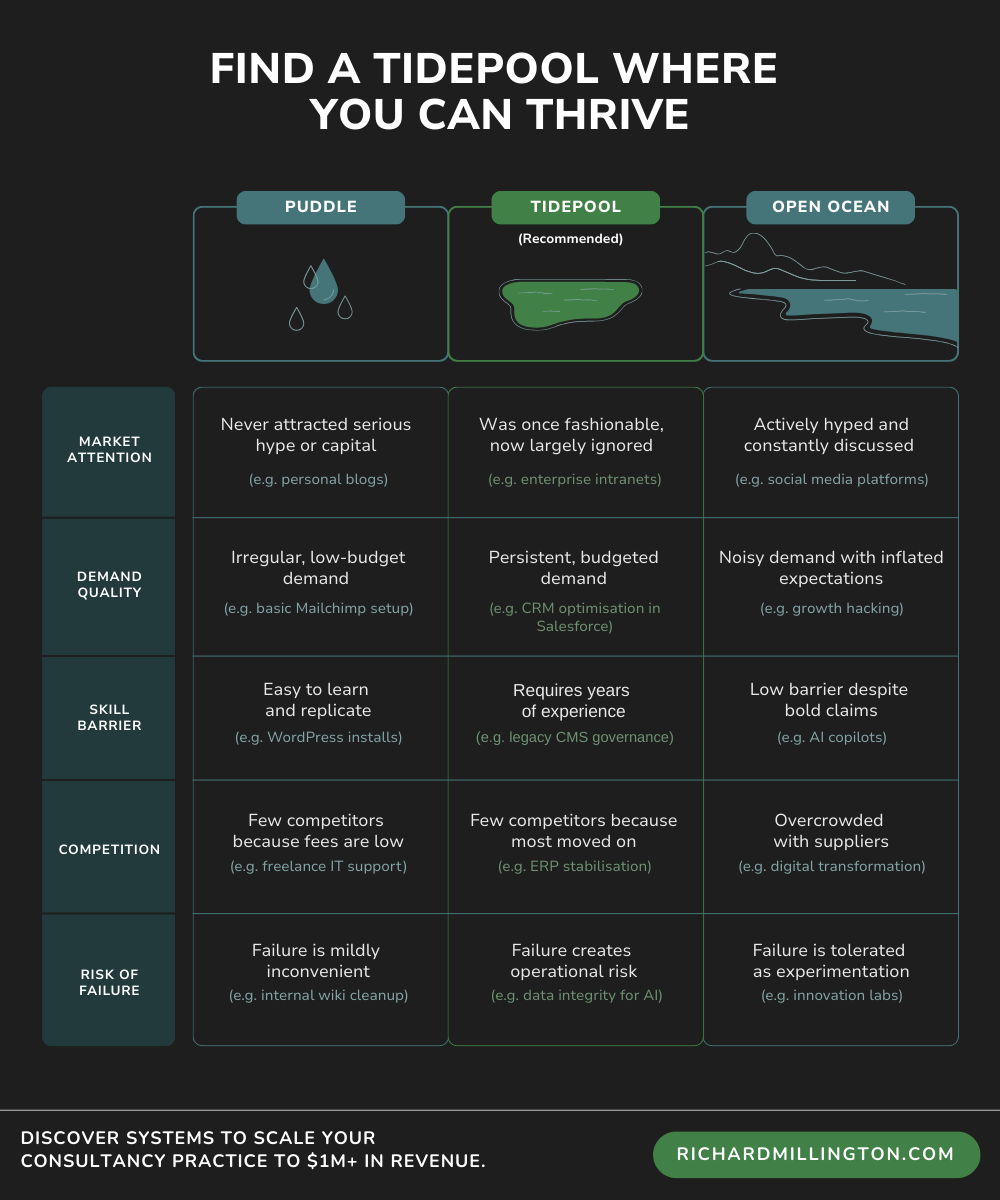
This is the niche that isn’t too large to attract major players (mid- to top-tier consulting firms), but isn’t too small that you can’t make a living from it.
It’s the niche where:
Clients spend a lot of money. The more money a client spends on something, the more likely they are to ensure it works. That creates a natural need for consultants who can improve their performance.
Clients struggle with complex problems. The more complex the activity, the more a client is likely to need external help. Part of the reason so many social media consultants struggled was that the new technologies themselves really aren’t that complicated to explain.
Competition is low. You don’t want to be competing with hundreds of people early in their careers, each making bombastic claims to attract attention.
Small enough to eliminate the major players. Your niche should be too small for major consulting firms to bother with.
Big enough to sustain half a dozen consultants. If you can’t find any consultants in that space, that isn’t a good sign. It suggests that tide pools can’t sustain enough life.
Most consultants thrive in sectors where competition is lower, the need is clearer, and it’s easier to build relationships and become broadly known in that space.
You don’t need to be doing something sexy; you need to be doing something that pays the bills.
If you want to ensure you select the right niche, I highly recommend signing up for the Consulting Foundations Program.
Some Critical Resources On Finding Your Niche:
Beyond The Niche: How To Package And Position Your Consulting Services
Six Rules For Picking A Niche Where You Can Become The Top Consultant
The Somewhat Secret Things We Do To Attract Enterprise Clients
Good luck!
Connect with Rich
Are you new to the newsletter? Subscribe for free
Follow me on LinkedIn for more insights
Learn to write persuasive business proposals with my Proposal Mastery course.
Get 1-to-1 personal coaching. Get a personal coach to help you grow your consultancy practice. Tackle topics like positioning, client acquisition, delivering exceptional value, industry leadership, and building the systems to thrive. Hit reply or learn more about my coaching approach.