
Select The Right Consulting Deliverables To Solve Client Problems
The art of selecting the right deliverables to solve different client problems and achieve the outcomes clients really need.

Hi, I’m Rich. Welcome to my weekly newsletter where I share systems and frameworks for scaling your consulting practice from $0 to $1m+ in revenue.
→ On March 16, I’m launching my Consulting Foundations Program. This program will ensure you’ve got the four critical decisions right in your practice. I hope you will consider signing up.
In today’s newsletter, I’m going to cover one of the key principles from the Consulting Foundations Program. We’ll cover how to offer the right deliverables and then turn them into a full package.
This also draws on my webinar a couple of weeks ago.
Consulting Is Selling Deliverables, Not Expertise
Many newcomers to consulting believe that consulting is essentially selling expertise. A client hires you, you give them your wisdom, and then you get paid. That sometimes does happen - but it’s rare.
To be clear, consulting isn’t selling your expertise.
It’s selling the tools clients can use to solve their problems and achieve their goals.
These tools are essentially your deliverables. They’re typically written into client contracts and what you get paid for (you should never be paid by outcome).
Deciding What Deliverables To Offer
In the earliest stages of a client engagement, you need to identify the type of problem the client is trying to solve.
These problems typically fall under:
Deciding what to do.
Knowing how to do it.
Building the ability to do it.
Avoiding mistakes.
Doing it/something better (process improvement/efficiency gains)
Measuring the results.
This probably isn’t a comprehensive list, but for most B2B consultants, most clients will fall into one or more of these areas.
You can identify the type of problem by asking the right $100k+ questions in the sales process.
Once you know the type of problem, you then need to decide what tools (deliverables) you need to create to help clients solve that problem.
Here’s a useful chart that might help:
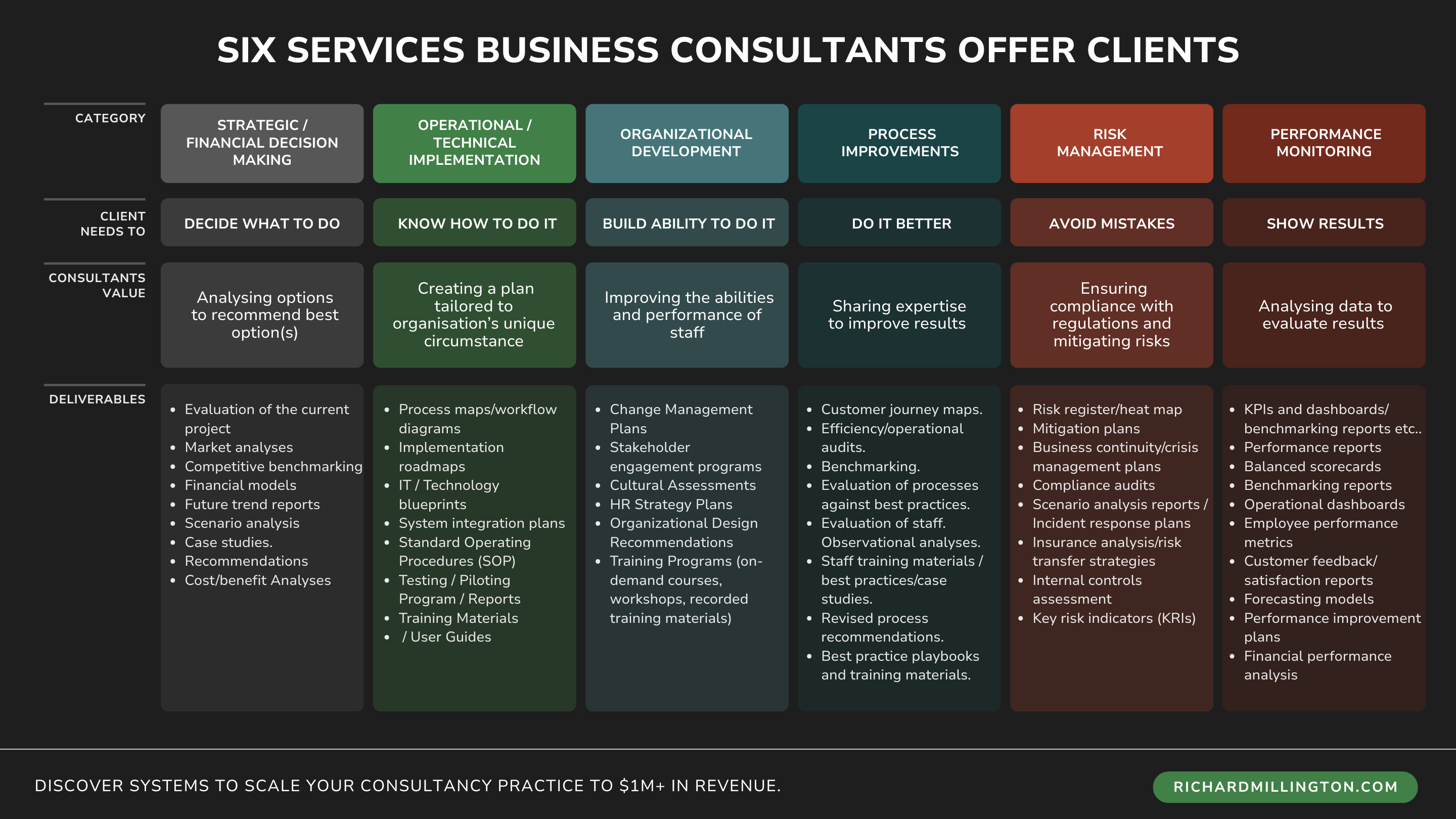

You can now match the problem type to the kind of deliverables you might create.
Aside: The language you use to describe the deliverables has a big impact on value perception.
Not every deliverable is suitable for every problem, but the critical thing is you have some idea of what tools you need to create to help your clients solve the problems they face.
Often in the solution design process you outline your initial ideas of what deliverables they need, get feedback, and adjust until you get it right.
Aside, once you know the deliverables you’re going to create, it becomes a lot easier to properly price the project (and negotiate your rates)
But Deliverables Alone Don’t Achieve Outcomes
Even if you follow the seven key rules for creating great deliverables
There’s a big difference between creating deliverables and achieving outcomes. Consultants are paid to create the deliverables, but careers are built on achieving the outcomes.
It’s tempting to agree on the deliverables, spend the next few months creating them, and then hand them over to the client. Job done!
The problem is that deliverables don’t achieve outcomes.
It’s a little like the well-intentioned NGOs that build wells in drought-stricken countries but fail to provide the necessary tools, knowledge, and processes to maintain them. It’s not long before they fall into disrepair and are abandoned.
Client deliverables can often fall into the same trap. Deliverables are tools. If an outsider (you) drops off the tools without making the additional effort to embed them within the client’s environment and community, the deliverables (the tools) will soon be abandoned.
And this happens far too frequently.
Three Critical Things To Ensure Deliverables Are Used
There are plenty of critical steps to ensure your deliverable lasts.
This is a more advanced level of consulting. It focuses on the long-term. Which means you need to achieve three things:
The deliverables needs to be frequently updated and adapted.
The deliverable needs to be used correctly.
The deliverable needs to be used consistently.
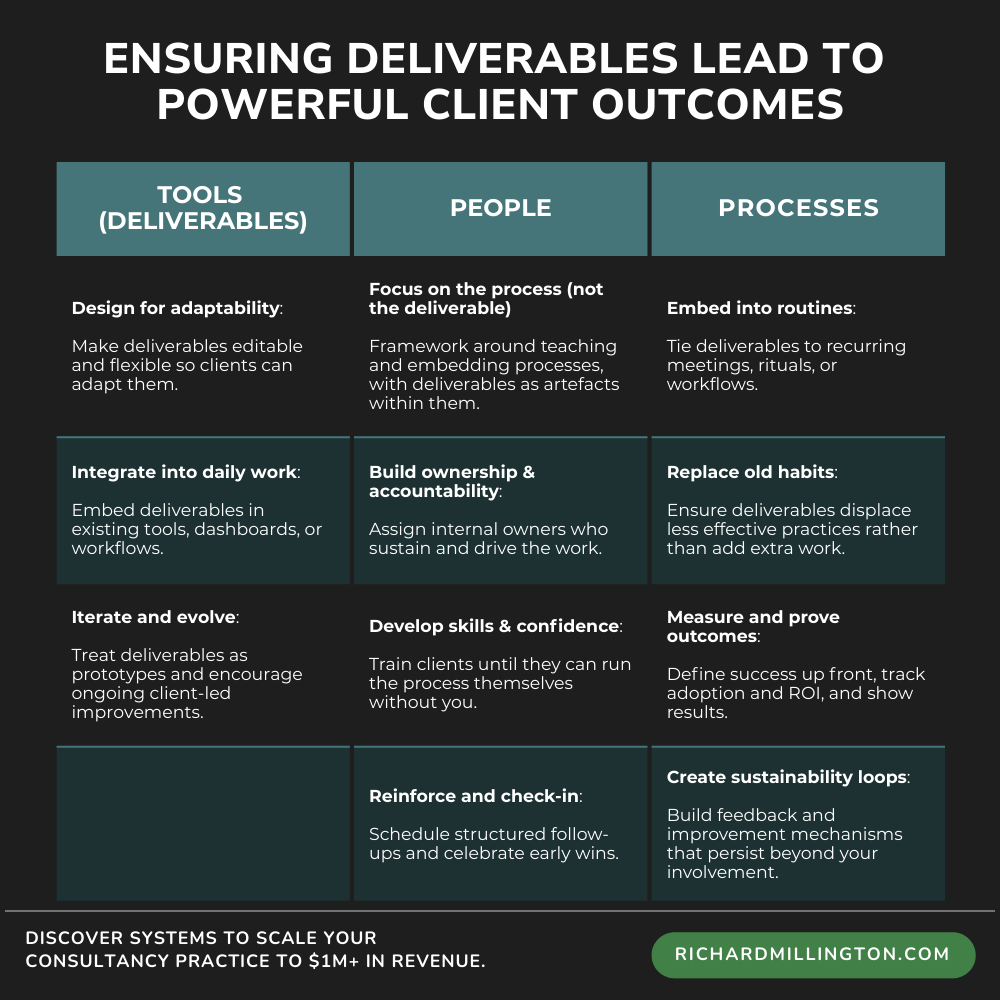
This is why in addition to the deliverables, you may also want to add three more specific things which aren’t tied to an artefact. These are:
Training to ensure stakeholders know the new process, how the deliverable is used in that process, and how to keep it updated etc…
Coaching in the new process. Different people might utilise the deliverables in different ways.
Quality checks and reviews to evaluate the results and make changes to the processes as needed. Don’t call them ‘check ins’. Focus on quality control here.
You can bundle these in a post-support package which includes a minimum, middle, and optimum tier.
Note: Remember how to properly package and position your services though (avoid, Bronze, Silver, Gold etc…)
Join The Consulting Foundations Program (March 16)
If you found this useful and want to learn more, then consider joining our Consulting Foundations Program.

The program will help you design the right consulting service offers and ensure you’re tackling the right kind of problems to help your clients.
Drop me an email if you have any questions.
This was a good read and very helpful