
How To Actually Do The Consulting Bit of Consulting
Consulting isn't exchange advice for money. It's designing solutions to solve complex problems that deliver real results. Here's how to do it.

Hi, I’m Rich. Welcome to my weekly newsletter, where I share systems and frameworks for scaling your consulting practice from $0 to $1m+ in revenue.
You can get 1:1 personal coaching or explore my new program: Indispensable Consulting Systems.
The Part of Consulting No One Teaches
If you’ve read many consulting books, you’ll find they focus on things like how to win clients, how to price your services, or how to position yourself in the market. All of that is important, but there’s surprisingly little about the work of actually doing the consulting: how to engage clients, solve their problems, and deliver lasting results.
Many people think consulting is being paid to give advice…like some messiah who shares some words of profound wisdom and then floats back away with a hefty paycheck.
The reality is a lot more complex. So let’s go through what the actual consulting part of consulting is really like and how to do it well.
Step 1: Get Crystal Clear on the Outcome
The most important step, before anything else, is to clarify what success looks like. What are the specific outcomes your client wants? What are the tangible deliverables?
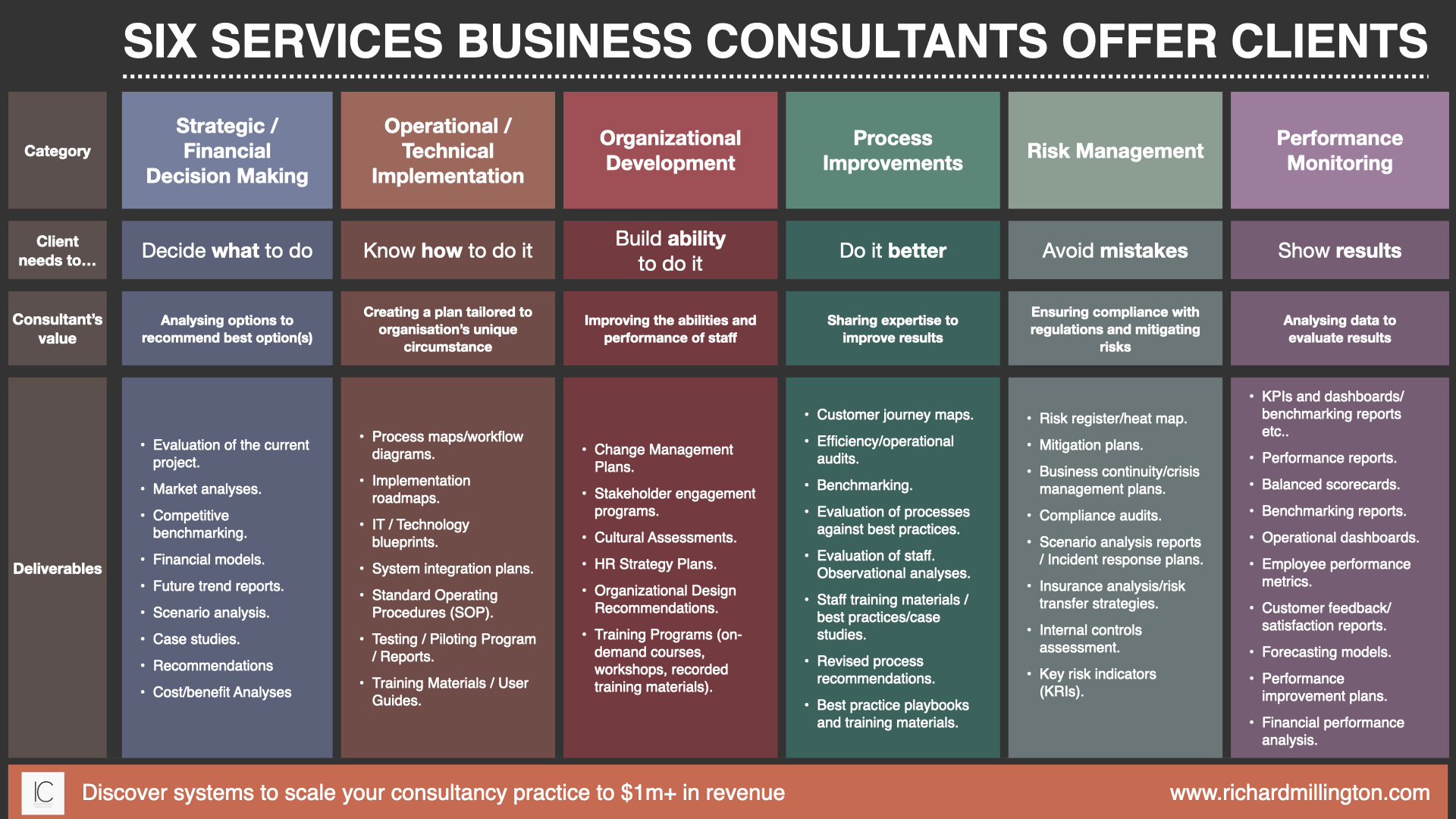
Even if this was discussed in your proposal, clarify it again at the beginning of the project. Assumptions kill projects faster than bad ideas. Alignment with the desired outcome is the foundation upon which everything else rests.
Never forget the principle of constant clarification here.
Step 2: Properly Diagnose The Problem
Consultants often jump to solutions too quickly - often from past experience.
Instead, you first need to deeply understand the problem you’re trying to solve.
You’re looking to answer:
What exactly is the problem we’re solving?
Who does it affect?
How severe is the problem? Can you quantify and measure it?
What are the root causes? (go as deep as you can)
Has anyone else in the industry solved it? What can we learn from them?
This is where stakeholder interviews, data gathering, and existing documentation come into play. You’re not just listening to what people say; they might not fully understand the problem themselves. You’re synthesising all inputs into a clear problem diagnosis.
Most problems are complex. They rarely have a single cause or obvious solution. This phase ensures you’re solving the right thing, not just the first thing.
You might come up with a problem statement like:
The customer support team is overwhelmed, yet customer satisfaction continues to decline.
Despite investing in new tools and expanding documentation, customers still struggle to find accurate answers and resolve issues without contacting support. Response times are increasing, agents are duplicating work, and different teams give inconsistent guidance. No one has a shared view of where breakdowns occur, which issues matter most, or what “good” looks like across the support journey.
As a result, effort is being spent producing content and fixes that feel useful but do not measurably reduce ticket volume or improve customer experience.
Step 3: Develop and Align Around Solution Options
Now you get into what’s known as solution design.
It’s critical here that you work hard to deeply understand the client’s context and situation before proposing solutions. Others will fall into the standard trap of proposing solutions that clients can’t implement.
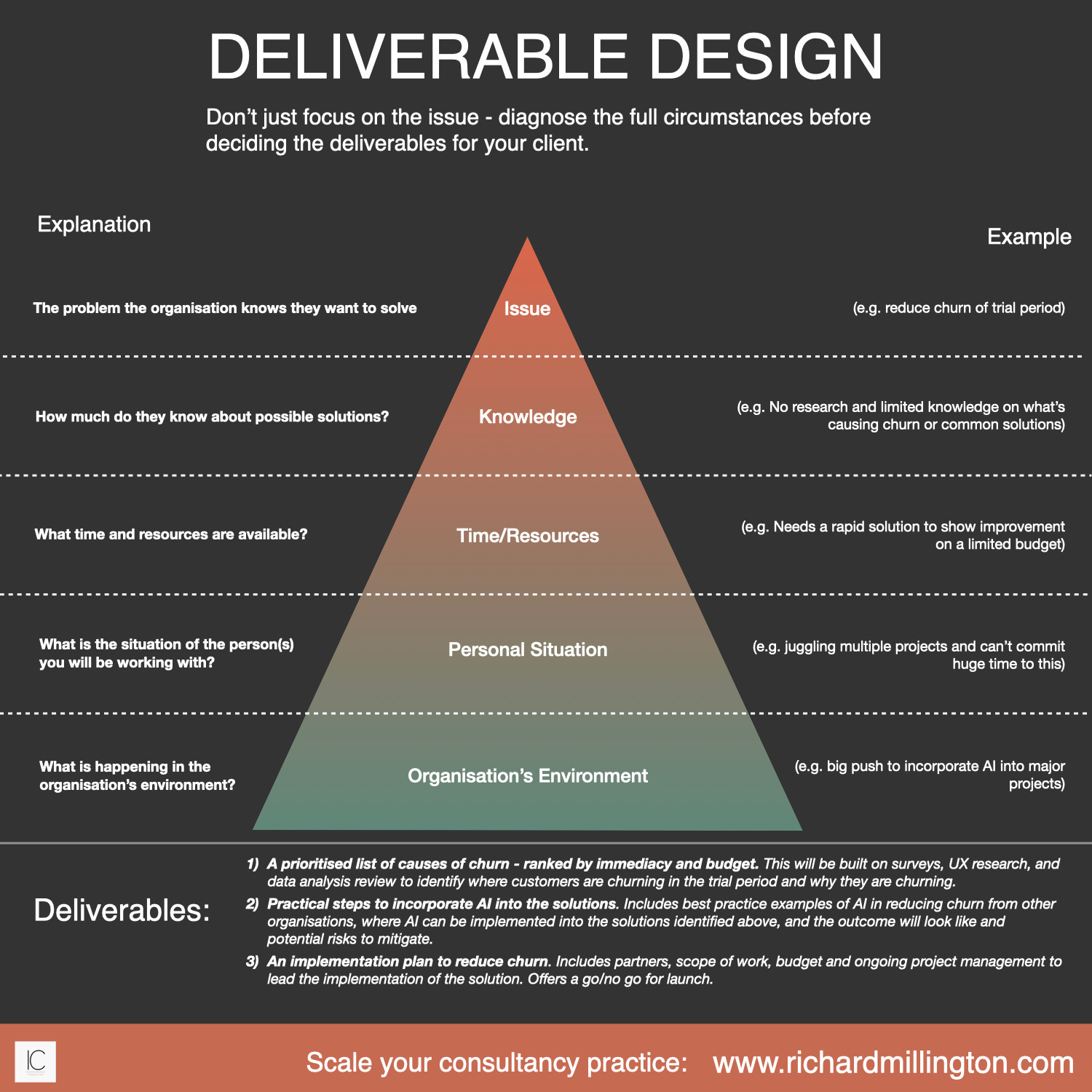
I often present multiple options—some low-cost, some high-impact, some low-risk, some more experimental.
This allows clients to see the trade-offs and to have a voice in the direction forward.
But the real value here is alignment. Getting all key stakeholders aligned around:
The nature and cost of the problem
The cause(s) of the problem
The best route forward
If a consulting project ever stalls, 90% of the time it’s because this alignment never fully happened. If everyone agrees on what the problem is and the right solution, execution becomes dramatically easier.
I can’t stress enough the need to explore the organisation’s level of knowledge, available resources, the abilities and time of the person you’re working with, and what’s happening in the broader environment.
(aside - This is often what turns five-figure contracts into six-figure contracts).
Once you’ve diagnosed the options, you can present the possible solutions and get broad stakeholder sign-off. The next step is the roadmap.
Step 4: Create the Roadmap
Only now should you begin building the roadmap. You’ll lay out the key steps, timeline, responsibilities, and required resources. Your expertise will guide the structure, but you can also draw heavily on best practices, research, and case studies of others who’ve solved similar problems.
This can take many different forms (and have different intensities of collaboration with the client), but for us it’s often:
GANTT chart timeline detailing the steps that need to be undertaken
Roles and responsibilities of the project team (and specifically when they will be required).
Selected vendors/person(s) to help implement the plan.
Costs at each stage of the process.
Sometimes the roadmap is broken into phases like:
Pilot or Prototype
Full Rollout
Evaluation and Handoff
At this point, you might be scoping out future work or continuing within the currently agreed scope of work. You need to get really granular about the steps required here.
Step 5: Implement the Solution (and make it stick)
If we think of the possible types of consulting and work channels as a decision tree, this is the level where it branches into infinity. I can’t begin to imagine all the possible solutions you might be helping clients implement. Some clients take this on themselves; other times, they want the consultant to do it.
There are broadly categories here:
Implementing The New Infrastructure/Technology
This involves actually creating a specific ‘thing’ that you’re meant to be creating.
It might include:
Leading the project working group in weekly meetings.
Ensuring each aspect of the plan is implemented to specification.
Identifying and resolving any issues that arise.
Ensuring lessons learns from peers are considered here.
Monitoring progress and making changes as needed.
Changing Human Processes
If the solution involves changes in human processes (as almost all will), you need to make your changes stick.
This involves a deeper understanding of human nature and creating the habit, incentive, and internal support structure to ensure those changes last.
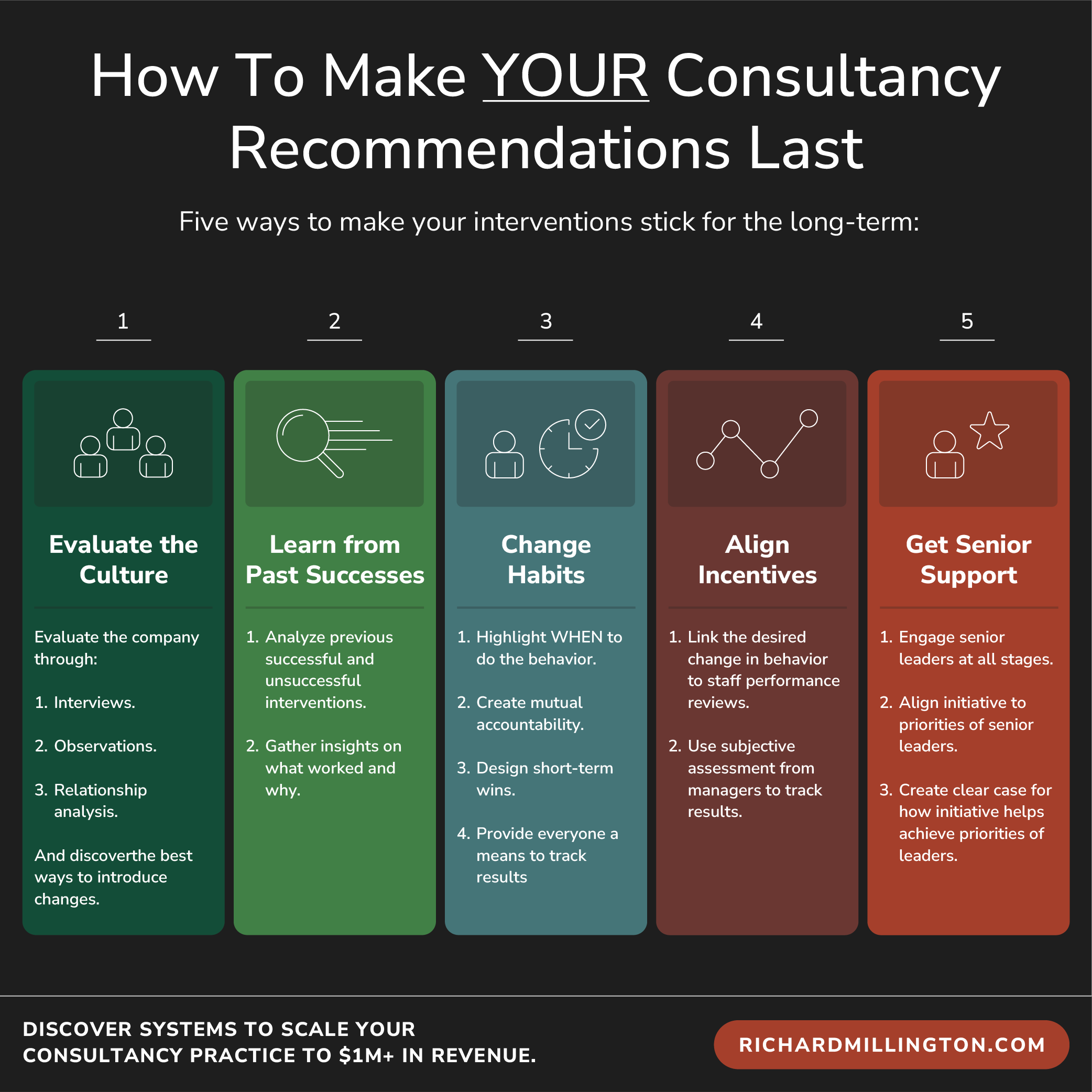
A lot of the activities at this stage involve:
Collaborating with those on the ground to create new habits to perform the behavior (i.e., instead of this, do that)
Aligning the incentive structure to the new behavior(s).
1:1 time engaging senior stakeholders.
Creating an ongoing working group to review the behavior and make future changes.
Step 6: Evaluation
The final step is the most neglected - but you should do it regardless of whether you’re paid to do it or not.
Evaluation will usually come in three forms:
Metrics. You review the performance indicators before the project commences and after it concludes. This is sometimes easy and sometimes impossible. The biggest challenge is that your engagement often ends well before the results come in, which makes it difficult to obtain the metrics. Please include it in your contract. Ideally, you can turn this into a clear ROI measure - but this is rare in practice.
Qualitative feedback from stakeholders. This is where you gather survey feedback or interviews with people before and after the change to track any changes in sentiment/attitude.
Did it meet spec? Did the project simply meet the client's specifications outlined at the outset? A critical part of using qualitative measures is turning the initial project requirements into an evaluative checklist before you begin. Another option is to benchmark the project against your standards before and after.
It’s good to ensure evaluation is part of the project scope, as it naturally leads to additional work and repeat clients in the future.
Consulting Isn’t Giving Advice
Consulting is the discipline of taking responsibility for change.
Advice is cheap. Opinions are everywhere. Clients want someone who can define what success looks like, diagnose what’s really going wrong, design solutions that fit their reality, and stay involved long enough to make the change stick.
This is why great consultants obsess over outcomes, not ideas. They slow down before jumping to solutions. They turn ambiguity into decisions, decisions into roadmaps, and roadmaps into action. They design deliverables not to look impressive, but to remove uncertainty and resolve the problem.
If you follow these steps, you’ll likely perform better than most.
Good luck!
Connect with Rich
Are you new to the newsletter? Subscribe for free
Follow me on LinkedIn for more insights
Learn to write persuasive business proposals with my Proposal Mastery course.
Get 1 to 1 personal coaching. Get a personal coach to help you grow your consultancy practice. Tackle topics like positioning, client acquisition, delivering exceptional value, industry leadership, and building the systems to thrive. Hit reply or learn more about my coaching approach.
The 'make it stick' section is where most consulting engagements fall apart. It's easy to design a solution. It's much harder to change how people actually behave day to day. The habit, incentive, and support structure piece requires staying involved longer than most scopes of work allow. The consultants who build that into their engagements from the start tend to get the repeat work.
My fav part: "Clients want someone who can define what success looks like, diagnose what’s really going wrong, design solutions that fit their reality, and stay involved long enough to make the change stick." Thanks for this reminder- great framework!