If You Want To Give Better Advice To Clients, Follow These Three Simple Rules
If you can avoid these three common mistakes, you will be doing better than most people.
Hi, I’m Rich. Welcome to my weekly newsletter where I share systems and frameworks for scaling your consulting practice from $0 to $1m+ in revenue.
You can get 1:1 personal coaching or explore my new program: Indispensable Consulting Systems.
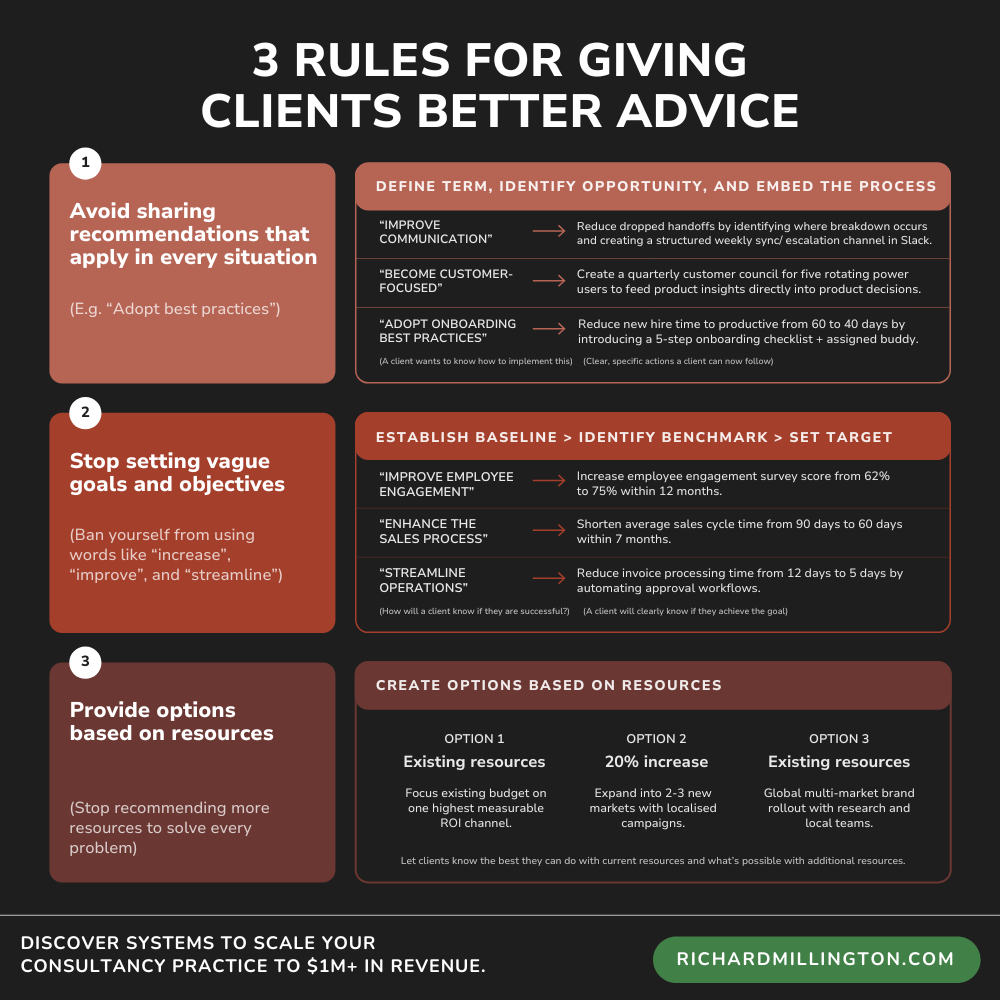
1) Avoid Recommendations That Always Apply
One of the most common mistakes consultants make is offering advice that sounds universally good but provides no real guidance. You shouldn’t use terms or phrases like “create an engaging experience,” “Improve communication,” or “implement UX best practices.”
Can you think of a situation where that advice WOULDN’T apply?
Me neither.
Of course, every organization wants to improve things and follow best practices - that’s not the issue. The reason they haven’t done it isn’t because they don’t have the means (knowledge/resources) or motivation to do it.
The real value lies in defining what those words actually mean within the client’s unique context. This includes
Define the term: What does “engaging experience” mean for this client? Is it higher session duration, more repeat logins, deeper product adoption, or something else entirely? What specific elements have to be in place to make it engaging? Once you define the term, everything becomes a lot clearer. Defining these things is part of the unique value you provide.
Identify the starting point: Where is the client today against that definition? Use data, observations, or benchmarking to show their current state. Benchmark where they are at today on this journey. Are they halfway there or nowhere in sight? Keeping score matters.
Map the path forward: Break down the specific elements they need to embed to close the gap. For instance, this might involve introducing a Q&A structure on their site, redesigning the onboarding process, or embedding customer stories into the user experience, among other options.
Once you start following this framework, you can turn generic recommendations into specific advice that helps clients.

This is where consultants earn their fee. You don’t just repeat the obvious; you contextualize it, measure it, and turn it into a plan. Generic advice makes clients roll their eyes. Defined, situational guidance makes them say: “Ah, now I see what to do next.”
If the client doesn’t know precisely what the ideal state is like and how to get there, you’ve failed.
2) Be Precise About the Goals (Outcomes) You’re Trying To Achieve
I want you to ban words like increase, improve, enhance, and streamline from your lexicon.
The problem is that none of these words makes it clear when you’ve achieved the goal.
Consider these goals you might create in a strategy:
Improve employee engagement
Invest in leadership training
Enhance the sales process
Increase brand awareness
Streamline operations
When will you know if you’ve achieved any of them?
For example, the phrase “improve employee engagement” is so vague that any improvement, no matter how slight, is considered a success.
These words invite endless interpretation and force the client to ask: “By how much? Compared to what? When do we know it’s finished?” Your job is to eliminate that ambiguity.
This means you need to set clear and specific targets (or SMART goals). The reason why most people don’t do this is that they don’t know what a feasible target is. This results in another common problem - plucking numbers out of thin air (usually nice, round numbers like 10%, 50%, etc.).
Without metrics for measuring success and a clear target, it’s impossible to prove you’ve succeeded.
Establishing the baseline. What’s the current trend if nothing changes? i.e., if sales figures are improving by an average of 5% per year, you can forecast what that might look like in the future ad infinitum. That’s your baseline.
Benchmarking realistically. Now, you need to research the impact of previous changes undertaken by the organisation and what other organisations have achieved with similar levels of resources. Explore what benchmarks exist in your sector and identify what’s feasible. Again, this is part of the unique value you offer and comes from your research calls.
Factoring in resources. Finally, consider the resources the organisation will invest. Theoretically, if the organisation invests 10% more, it should achieve at least a 10% lift above the baseline. This is a very crude metric, but it provides a starting point for your work. If the investment remains the same, then you shouldn’t expect 100% improvements unless it’s clear where that would come from.
Every metric in your recommendations should be defensible and supported by evidence. You should be able to point to a calculation, however crude, and justify why that figure is there.
Now the recommendations become clear and measurable. For example:
Notice the difference: the revised versions are specific, credible, and leave no ambiguity about what success looks like. A client will be able to review this and determine exactly when they have achieved this goal.
3) Identify And Embrace The Constraints
The easiest thing to do is to tell an organisation to invest more resources to achieve a goal. I recall a United Nations consultant who recommended a substantial increase in spending for the fundraising department and a comprehensive reorganisation of the organisation.
The problem with this is that it’s not helpful. On rare occasions, it may be possible to increase the budget, but the vast majority of the time, it is fixed, and you have to work within it. The organisation isn’t looking for you to tell them you spend more. They’re often looking for your advice on how to spend better and deliver better results.
This naturally varies by the deliverable (see below), but most of the time, the challenge isn’t to pretend the constraints don’t exist, but to clearly define them and outline what can be done within them.
If you really want to make a case for more resources, split your recommendations down by:
What can be done within the current constraints.
What can be achieved with a 10 to 25% increase in resources (or change in the constraints)
What would be ideal if the program had the resources to match the ‘best world’ benchmarks of other organisations?
In this example, you can see how we’ve broken down the options into what we can do with existing resources, what we can do with increased resources, and what a fully resourced option might look like. This enables the client to decide on the best path forward that is practical for them.
Good luck!
Connect with Rich
Are you new to the newsletter? Subscribe for free
Follow me on LinkedIn for more insights
Learn to write persuasive business proposals with my Proposal Mastery course.
Get 1:1 personal coaching. Get a personal coach to help you grow your consultancy practice. Tackle topics like positioning, client acquisition, delivering exceptional value, industry leadership, and building the systems to thrive. Hit reply or learn more about my coaching approach.


